AI Spending Boom Cracks: Where Did the Returns Go?
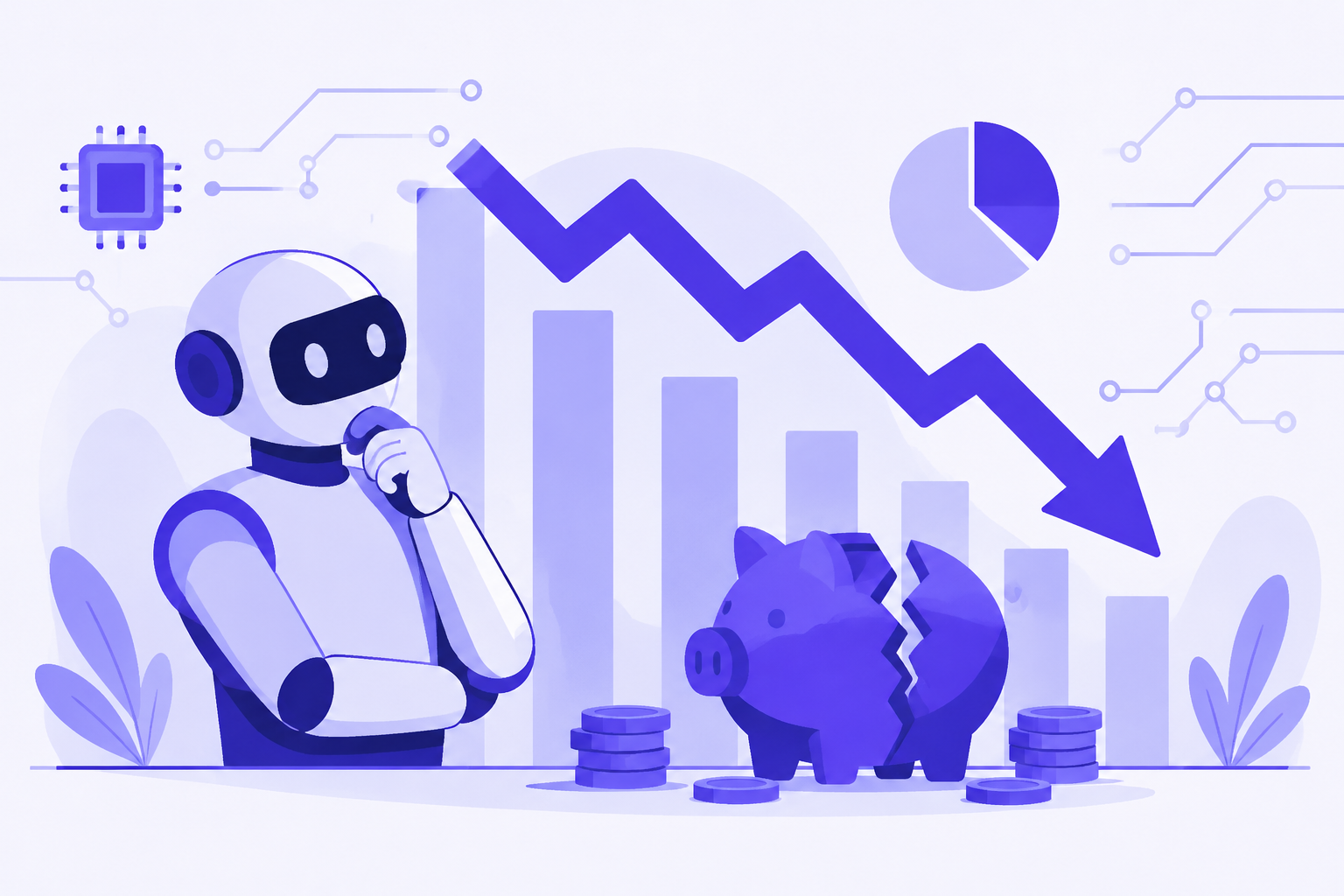
In fall 2026, TechCrunch published a piece titled *Cracks Are Emerging in the AI Spending Boom*. The headline was measured; the signal wasn't. After 18 months of near-religious faith in AI infrastructure investment, the cracks are no longer theoretical. OpenAI's latest funding round reportedly fell short of its target. Anthropic's IPO, according to Blackstone's analysis, is likely to land it a high-yield — read: junk — credit rating. The money is still flowing, but the question has changed. It's no longer *how much can we deploy?* It's *where, exactly, is the return?*
$300 Billion a Year — and the Math Still Doesn't Work
Microsoft, Google, Meta, and Amazon have collectively pushed their annualized capital expenditure past $300 billion, a substantial chunk of which is going into GPU clusters, liquid-cooled data halls, and dedicated fiber networks. The scale is genuinely staggering, but the detail that captures the moment best is this: Nvidia is reportedly considering acting as a co-guarantor on financing for Nscale, an AI data center project in West Virginia. When the company selling the chips has to backstop loans because investors are losing faith in the underlying projects, that's not a footnote — that's a structural signal about where infrastructure financing confidence actually stands.
xAI's Memphis data center is contending with a different kind of cost. The NAACP filed suit alleging Clean Air Act violations, and the court allowed the case to proceed. Environmental compliance has been a long-underpriced liability across the entire industry. That's starting to change.
Intel's story illustrates the supply-chain ripple effect. AI's voracious appetite for memory and specific components drove up PC component prices broadly, and Intel's stock shed $12 billion in market cap as a result. The infrastructure buildout isn't happening in a vacuum — it's squeezing the rest of the semiconductor ecosystem in ways that compound the overall cost picture.
The Companies Carrying the Risk
| Company | Flagship Model | Valuation | Pressure Point | |---|---|---|---| | OpenAI | GPT-5.5 | ~$300B | Latest funding round missed targets | | Anthropic | Claude Opus 4.8 | ~$60B | Projected junk credit rating post-IPO | | xAI | Grok series | ~$50B | Active environmental litigation | | Google DeepMind | Gemini 3 | (public parent) | Capex up >50% YoY |
Anthropic deserves particular attention. A junk credit rating isn't just a PR problem — it directly raises the cost of every subsequent debt financing round. The dynamic is self-reinforcing in the wrong direction: burn fast, borrow expensively, tighten cash flow, repeat. Claude Opus 4.8 is genuinely excellent. Technical leadership and financial health are two different scorecards, and right now they're diverging.
On the OpenAI side, Sam Altman has argued that compute is better centralized in data centers than distributed on end-user hardware. The logic of that position is defensible. The reality it reflects is less comfortable: OpenAI requires a continuous, massive intake of compute resources to run its services, and at current monetization rates, breaking even on that remains a distant target.
Why Enterprise Revenue Keeps Disappointing
The core tension driving the AI spending boom cracks is simple: infrastructure is expanding faster than commercial revenue. The enterprise market, which was supposed to be the engine of monetization, is moving at a pace that doesn't match the investment thesis.
Compliance and data sovereignty slow everything down. In finance, healthcare, and government — the verticals with the budgets to actually matter — deploying an LLM requires security audits, data residency guarantees, and regulatory sign-off. A large bank moving from internal approval to live deployment typically spends 12 to 18 months just on compliance processes. That's before a single token is generated in production.
Integration costs are consistently underestimated. Calling an API is easy. Embedding GPT-5.5 or Claude Opus 4.8 into an existing ERP, CRM, or internal knowledge base requires prompt engineering, RAG pipeline architecture, permission isolation, and monitoring infrastructure. A significant number of enterprise proof-of-concept projects stall at this stage and never proceed to purchase.
ROI is genuinely hard to quantify. Engineering teams using Claude Code or Codex are faster — that part is real. Translating that speed into a number that satisfies a CFO's standard for capital allocation remains an unsolved accounting problem. Without a credible ROI framework, procurement committees default to caution.
The consumer side has its own ceiling problem. Ollie, an AI assistant that positioned itself on privacy, shut down this year — a clean example of how thin user willingness to pay actually is. Apple, meanwhile, has been conspicuously restrained about AI. Its CEO said publicly he has no interest in building AI for AI's sake, and Apple Intelligence — after multiple delays — is only now entering the Chinese market with iOS 27.3. That restraint is a business judgment: before a killer app exists, aggressive commitment burns money without building a moat.
What Developers and Enterprise Decision-Makers Should Do Now
The infrastructure buildout isn't collapsing. But it's entering a harder selection phase, and the decisions you make in that environment carry more consequence.
Stop treating platform stability as a given. Pricing structures, API reliability, and feature roadmaps can all break in nonlinear ways when a provider is under funding pressure. Any core business function that depends entirely on a single model vendor is a concentration risk. Maintaining multi-model flexibility is no longer an engineering preference — it's a hedge.
Optimize for inference cost, not just benchmark rankings. GPT-5.5 and Claude Opus 4.8 are impressive. They're also the fastest way to exhaust an API budget. For the majority of production use cases, models like Haiku 4.5 or GPT-5.4-mini deliver the necessary output at a fraction of the cost. Matching model to task isn't a compromise — it's the only way to make the economics work.
Factor environmental compliance into infrastructure vendor selection. The xAI litigation is an early signal of a cost that will get priced in more broadly. A vendor's energy sourcing, data center location, and compliance history are now legitimate evaluation criteria, not just ESG checkbox items.
Standardize your CLI toolchain now. Claude Code, Codex, and Gemini CLI have established themselves as the first-tier developer tools. Choosing infrastructure that supports all three reduces future migration friction considerably.
---
On the practical side of managing all this: the inference cost pressure is real, and switching between providers manually is painful. I use XycAi as my single access layer — one OpenAI-compatible API covering 200+ global models, including GPT-5.5 and Claude Opus 4.8, at prices starting from 14% of list. One-command setup works across Claude Code, Codex, and Gemini CLI, which means I'm not locked in anywhere when the landscape shifts again — and at this pace, it will.