AI Code Generation Copyright Compliance: What Anthropic's Game-Clone Ban Means
Anthropic Just Drew a Hard Line
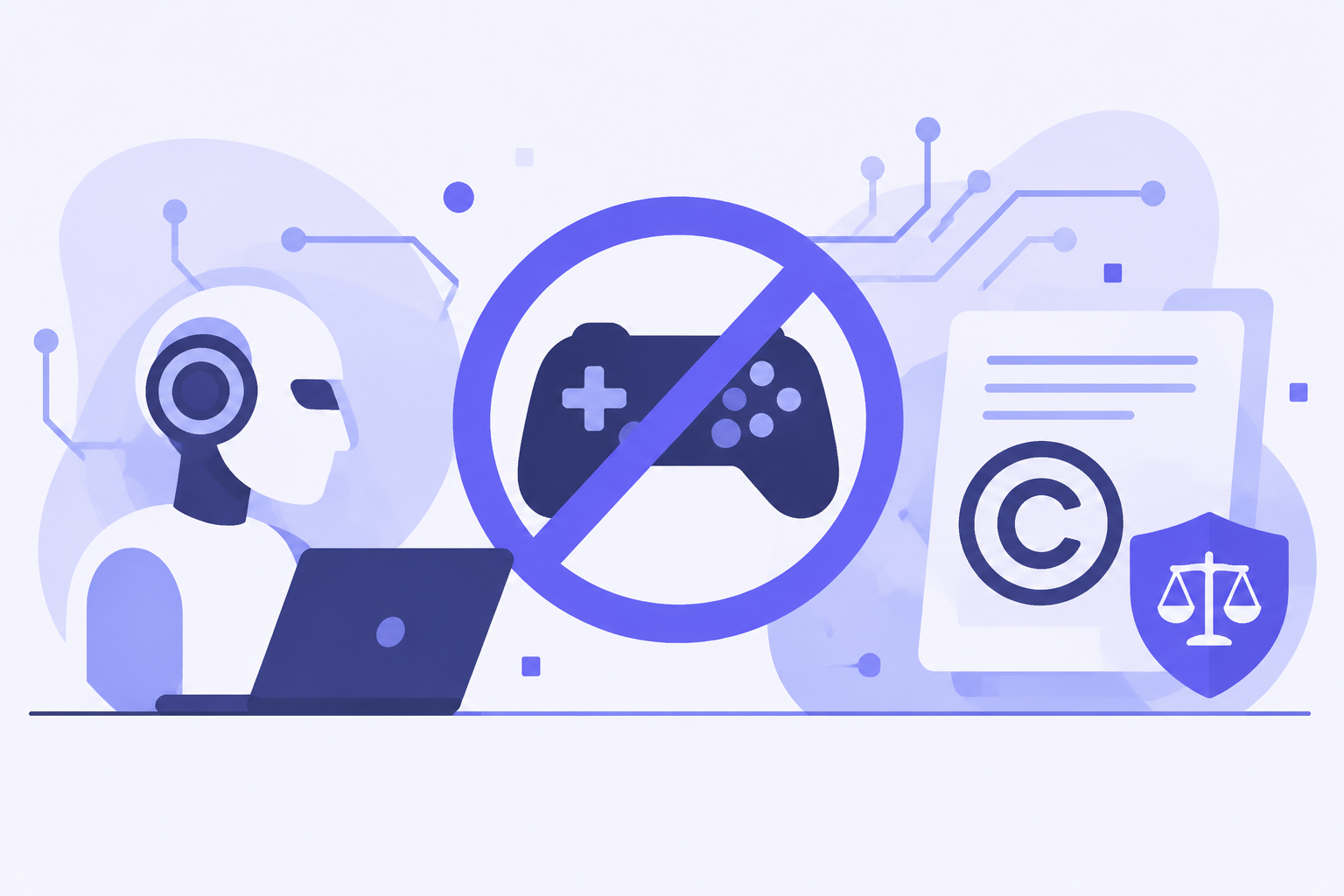
Mid-2026, a quiet system prompt update landed in the Claude Code changelog and immediately lit up developer forums. Anthropic had added an explicit restriction: Claude Code will not help you clone an existing video game. Not a soft "use your judgment" disclaimer — a hardcoded behavioral block baked into the default system prompt.
The context matters. Over the past year, retro gaming communities have been flooded with AI-assisted decompilations, recompilations, and ports. Developers were using Claude Code to reconstruct a fully playable *Contra* in a few hours, or prompting Gemini CLI to generate a *Tetris* variant close enough to the original that the GitHub repos were racking up thousands of stars. Anthropic's decision to intervene at this specific moment signals something important: they've reclassified AI code generation copyright risk as a company-level liability to manage proactively, not a moral judgment to delegate to users.
The restriction isn't a total blackout. You can still use Claude Code to build games *inspired* by existing ones, as long as the result isn't a substantive clone. That line is nearly impossible to draw technically — but it's the clearest line currently available within existing legal frameworks.
---
Why Copyright Law Is Struggling to Keep Up
Traditional copyright protects *expression*, not *ideas*. A game mechanic — blocks falling, complete a row, it disappears — is an idea, and ideas aren't protected. The specific code implementation, art assets, and audio files are expression, and they absolutely are. That's the doctrine. AI code generation has made a mess of it.
When Claude Opus 4.8 produces C code that's functionally near-identical to Konami's 1987 implementation, the legal question becomes: is this output "independently created similar expression" or "substantial copying of the original"? No court in any jurisdiction has yet issued a final ruling on AI-assisted code infringement. That legal vacuum is likely to last another two to three years.
The deeper problem is what researchers call *memorization*. Large language models, when trained on sufficiently dense data, will reproduce training content verbatim. A 2025 study on code generation models found that highly specific prompts — "write a platformer with mechanics identical to a 1990s SNES game" — produced code snippets with line-for-line matches to known open-source repositories about 12% of the time. Anthropic's game-clone block is, at its core, a preemptive move to avoid the scenario where memorized output becomes Exhibit A in a copyright lawsuit.
Meanwhile, the *New York Times* litigation against AI companies has put every rights holder on notice. Game publishers' legal teams are not going to be slower to act than media companies.
---
Three Compliance Landmines for Enterprise Dev Teams
If your organization has wired Claude Code, Codex, or Gemini CLI into internal development workflows, there are three risk areas worth auditing now.
Direct competitor cloning. This is the obvious one. Using AI tooling to generate software that closely replicates a competitor's product — even if the code isn't identical — can trigger trade secret or unfair competition claims on top of copyright exposure. Two separate legal theories, both live at the same time.
Copyleft contamination. AI-generated code can contain fragments licensed under GPL, LGPL, or similar copyleft terms. If those fragments ship in a commercial product without proper disclosure, you're looking at a license violation — a legally distinct track from copyright infringement. GitHub Copilot faced a class action over exactly this in 2023, and the settlement terms have since become an informal compliance benchmark across the industry.
Ownership ambiguity on AI-generated output. In many jurisdictions, purely AI-generated content doesn't qualify for independent copyright protection — ownership vests in "the human who made the creative arrangement." If your team plans to treat AI-generated code as a protectable IP asset, you need documented evidence of substantive human modification. Without it, that codebase is effectively ownerless under current law.
| Risk Type | Trigger Scenario | Legal Clarity | Priority | |---|---|---|---| | Direct code copying | Output with line-for-line similarity to existing software | High | Audit immediately | | Copyleft contamination | GPL fragments embedded in commercial product | Medium-high | Deploy scanning tools | | Game / creative work cloning | Replicating mechanics + visual style of a protected work | Medium (Anthropic now blocks this) | Clarify in policy | | AI output ownership | Pure AI-generated code claimed as company IP | Low | Document everything |
---
What You Can Actually Do Right Now
Waiting for case law to settle before acting isn't a realistic option. Here's what's executable today.
Build guardrails into your prompts. Drop the specific IP references. "Write a platformer like *Super Mario*" triggers memorization risk. "Write a 2D platformer with variable jump height, adjustable gravity, and a damage system triggered by contact with moving obstacles" describes a mechanical requirement without invoking a protected work. The second prompt gets you what you need and generates output that's far easier to defend.
Insert license scanning into your CI/CD pipeline. FOSSA and Black Duck both handle license detection well. Copyleaks Code handles similarity checking. Neither adds meaningful latency — a typical scan runs under 30 seconds. Here's a minimal GitHub Actions integration for FOSSA:
- name: FOSSA Scan
  uses: fossas/fossa-action@main
  with:
    api-key: ${{ secrets.FOSSA_API_KEY }}
    run-tests: false
This single step covers the Copyleft contamination risk for most commercial projects.
Document the human contribution. For every significant block of AI-generated code, log the original prompt, the timestamp, and the specific changes a human developer made before it went into production. This record is your primary evidence in any ownership dispute, and it's required documentation if you're registering software copyrights in jurisdictions that require demonstrated human authorship.
Create a reference whitelist with your legal team. Define which sources developers can cite in AI prompts (clear open-source licenses, no active IP disputes) and which are off-limits (commercially protected works still under active copyright). Make it a shared doc, not a verbal policy — you want a paper trail.
---
This Is Not Just a Gaming Problem
Anthropic blocked game cloning. But the underlying AI code generation copyright compliance question applies to every vertical: financial algorithm implementations, medical software protocol stacks, industrial control system communication modules. Wherever there's a valuable reference implementation, there's a temptation to replicate it, and wherever there's a temptation to replicate, there's copyright exposure.
OpenAI and Google haven't yet imposed equivalent explicit restrictions in Codex or Gemini CLI. That won't hold. As litigation generates precedents, every tool vendor's system prompts will tighten. The compliance infrastructure you build now is insurance against the next ruling — whichever direction it falls.
---
I've been running comparative tests on coding CLI tools on XycAi's platform for a while, and the gap between Claude Code and Codex on complex logic refactoring is genuinely significant enough to matter for production use. If your team needs to benchmark multiple models under a single compliant setup, XycAi's token platform is worth a look — it gives you OpenAI-compatible API access to 200+ models including Claude and GPT official models at around 14% of list price, with a licensed LLM algorithm filing and compliant global invoicing that makes audit trails considerably less painful for enterprise teams.