Fine-Tuning vs RAG: Which One Fits Your Enterprise Knowledge Base?
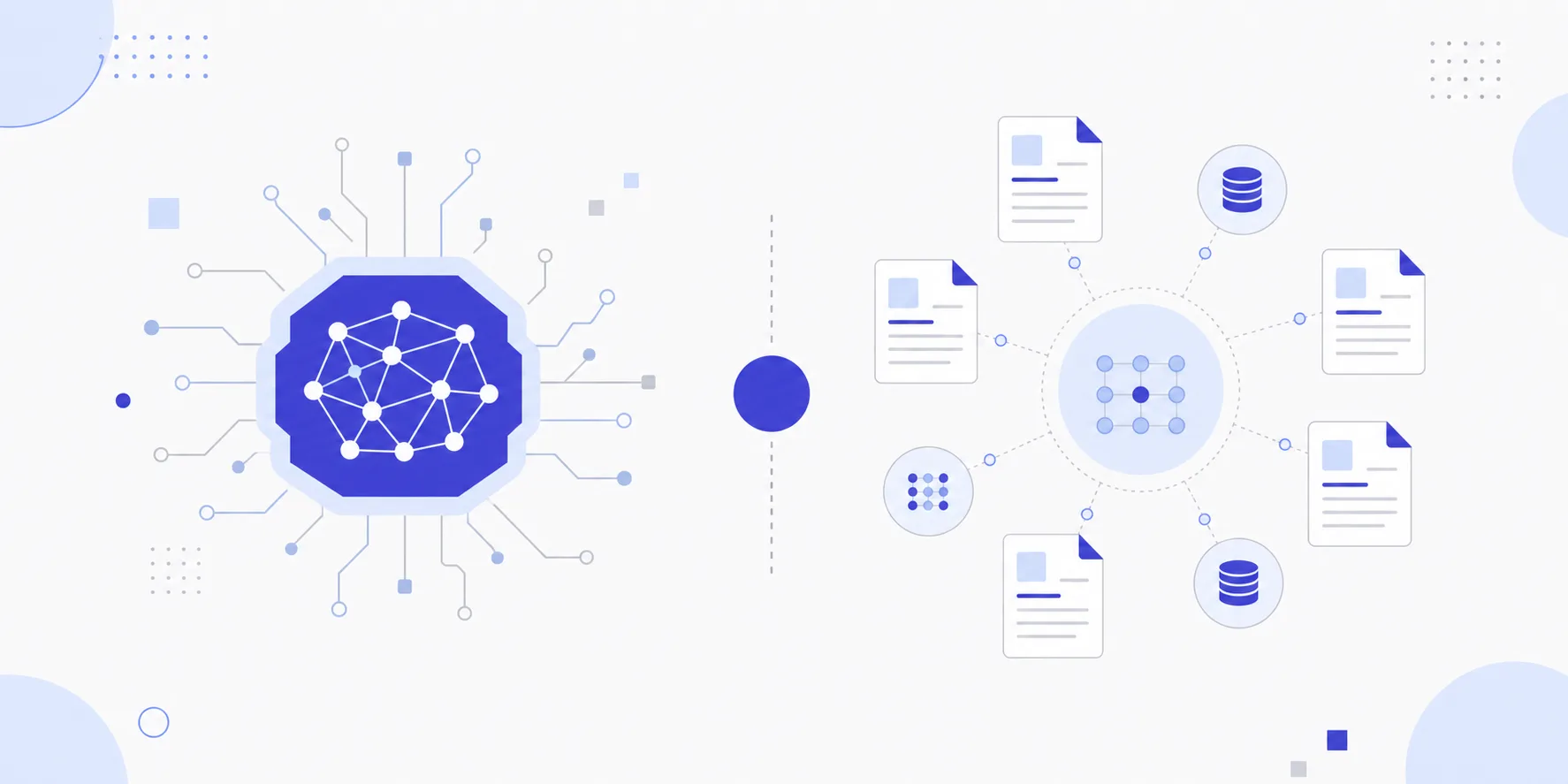
Every enterprise AI project hits the same fork in the road early on: fine-tune the model on your private data, or build a RAG pipeline? The choice shapes the next several months of engineering work and sets a ceiling on what the system can actually do.
Both approaches give the model access to proprietary knowledge. The underlying logic is completely different. So is the right answer for any given project. Instead of the usual "it depends on your use case" non-answer, here's a concrete breakdown across four dimensions — data volume, update frequency, cost, and output quality — so you can make the call before committing resources.
What actually separates the two
Fine-tuning bakes knowledge directly into model weights. You continue training on a private dataset, the parameters change, and at inference time the model recalls answers from within itself — no external lookup required. The tradeoff: once training finishes, that knowledge is frozen.
RAG gives the model an external memory it can query on demand. Documents get chunked, embedded into vectors, and stored in a vector database (Pinecone, Weaviate, Milvus, or similar). At inference time, the pipeline retrieves the most relevant chunks and passes them into the prompt. Model weights stay untouched; the knowledge base can be updated any time.
That structural difference drives everything else.
Four dimensions, clear decisions
Data volume
Fine-tuning is sensitive to data volume in a way RAG simply isn't. For LoRA fine-tuning on a model like LLaMA or Qwen 3, you need roughly 1,000–5,000 high-quality instruction pairs to see consistent results. Getting the model to genuinely internalize a domain's style and terminology usually requires 10,000+ examples. Below 500 examples, fine-tuning tends to overfit and generalize poorly — you end up with a model that's worse, not better.
RAG has no such floor. Twenty PDFs work fine. And at scale, RAG actually gets stronger: you can index hundreds of thousands of pages into a vector store and retrieve relevant passages in milliseconds. No amount of fine-tuning can pack that volume of knowledge into model weights.
Rule of thumb: if your document corpus exceeds 100k tokens and keeps growing, start with RAG.
Update frequency
This is where the gap is most dramatic. Product manuals, pricing sheets, compliance policies — these change quarterly or monthly at many companies. Every fine-tuning update requires a full retraining cycle: data cleaning, training run, evaluation, deployment. Even with LoRA for incremental updates, that process takes 2–7 days end-to-end. There's also catastrophic forgetting to manage — new training data can degrade the model's retention of older knowledge.
RAG updates are a different story. Re-embed the changed document chunks, push them to the store, mark old versions stale. The whole operation takes under 15 minutes. The freshness of your knowledge base is essentially limited only by how fast you can update your files.
Rule of thumb: if knowledge changes more often than once a month, RAG is the only operationally viable option.
Cost
Cost breaks into two buckets: upfront build cost and ongoing operational cost.
| Fine-tuning | RAG | |
|---|---|---|
| Initial build cost | High — GPU compute (A100 ~$2–3/hr; a 10k-sample LoRA run costs roughly $50–200) | Low — mainly embedding API fees (typically under $1 per million tokens) |
| Knowledge update cost | High — retraining on every update | Near zero — incremental re-embedding |
| Inference cost | Low long-term if self-hosting open-source models | 10–40% higher token usage per query due to retrieval context |
| Engineering complexity | Medium — requires training infrastructure | Medium-high — requires maintaining a vector store and retrieval pipeline |
If you're self-hosting an open-source model like DeepSeek V3 or Qwen 3, the one-time fine-tuning cost amortizes reasonably well over time through cheap inference. If you're calling a closed API like GPT or Claude, the fine-tuning endpoint itself costs significantly more than the base model — in that scenario RAG is almost always the more economical choice end-to-end.
Output quality
Quality depends heavily on what the task actually is.
Style and tone consistency: Fine-tuning wins here. When you need the model to internalize specific terminology, a particular register, or strict formatting conventions, baking that into the weights produces more reliable results than trying to enforce it through prompt examples. RAG-based style injection via few-shot prompting is inconsistent.
Knowledge retrieval and Q&A accuracy: RAG has a structural advantage. The retrieved source chunks appear directly in context, giving the model something concrete to work from. Hallucination rates are meaningfully lower. Fine-tuning can produce a model that confidently generates plausible-sounding but wrong answers — especially on long-tail knowledge — because it "thinks" it knows something it only half-learned. In standard enterprise FAQ evaluations, RAG typically reduces hallucination by 30–50% compared to fine-tuning, and every answer can be traced back to a source document.
A practical decision sequence
When you're evaluating a new project, run through these questions in order:
- Does knowledge update more than once a month? → Go with RAG. Fine-tuning is off the table.
- Is the total document volume over 100k tokens? → RAG is easier to maintain, unless style unification is a hard requirement.
- Is the core requirement about consistent tone, voice, or format? → Fine-tuning is worth considering.
- Limited budget, no GPU access? → RAG has a much lower starting cost; use a smaller model like GPT-4o mini or Claude Haiku for retrieval and generation.
- Do answers need to be traceable to specific source documents? → RAG supports this natively. Fine-tuning cannot.
The two approaches aren't mutually exclusive. Many mature enterprise AI deployments use a RAG + lightweight fine-tuning combination: RAG handles freshness and traceability, while fine-tuning shapes the model's output style so it sounds like the company rather than a generic assistant.
Run a POC before you commit
Theory is useful; data from your actual documents is better. Before locking in an architecture, run a quick proof of concept on both sides.
RAG POC: Take 200 representative documents, embed them with text-embedding-3-small or bge-m3, store them in Chroma locally, then write 20 real questions and evaluate retrieval accuracy manually. This takes one working day from scratch.
Fine-tuning POC: Prepare 200–500 question-answer pairs, run a LoRA fine-tune on Qwen 3-7B using Unsloth with 4-bit quantization (consumer GPU is enough), and run the same 20 questions. Budget 3–5 working days.
Put both POC results side by side. The data will tell you more than any framework analysis.
When you're running POCs across multiple models — comparing how GPT-4o, Claude Sonnet, and DeepSeek V3 each behave in a RAG or fine-tuning setup — switching between platforms adds friction you don't need. I use XycAi for this: one OpenAI-compatible API endpoint covering 200+ global models, with GPT and Claude official models available at around 14% of list price. It keeps the evaluation loop tight so you can focus on the actual results instead of credential management.
One API for 200+ global AI models
GPT · Claude · Gemini official models from 14% of list price. Licensed LLM filing, CN2 direct connect at ~5ms, compliant global invoicing.
Try XycAi →