Financial AI API Data Security: A Compliance Engineering Guide
The gap between shipping and compliance
AI APIs are moving into financial infrastructure faster than compliance teams can respond. When a developer drops a JSON payload with customer data into a request to GPT-5.4 or Claude Opus 4.8, that request has already left the internal network. Where the data flows, where it's stored, whether it feeds model training — none of that is under your control anymore.
This isn't a hypothetical risk. It's the baseline reality of financial AI API data security. China's Data Security Law (DSL), Personal Information Protection Law (PIPL), and the CBIRC's data classification requirements have drawn clear lines. What follows is those regulations translated into engineering terms.
What you cannot send to a third-party API, full stop
Financial data is typically classified at three levels: public, internal, and sensitive. The fields below fall into the category that must never be transmitted in plaintext to any external API — no exceptions.
| Category | Typical Fields | Regulatory Basis |
|---|---|---|
| Identity | National ID, passport, driver's license | PIPL Article 28 (sensitive personal information) |
| Financial accounts | Bank card, securities account, fund account | Banking Data Security Management Measures |
| Auth credentials | Passwords, PINs, security answers, OTPs | Same as above |
| Biometrics | Facial feature vectors, fingerprint templates, voiceprints | PIPL Article 28 |
| Transaction details | Exact amount + timestamp + merchant (in combination) | DSL Article 21 |
| Location history | Continuous records precise to street level | PIPL Article 28 |
| Credit report raw data | PBOC credit report content verbatim | Credit Reporting Industry Regulations |
Pay attention to the combination effect. A name alone isn't sensitive. But name + phone number + account balance range in the same prompt creates a combination that uniquely identifies an individual — and that combination lands in the same restricted category as any of those fields alone.
Engineering the masking pipeline
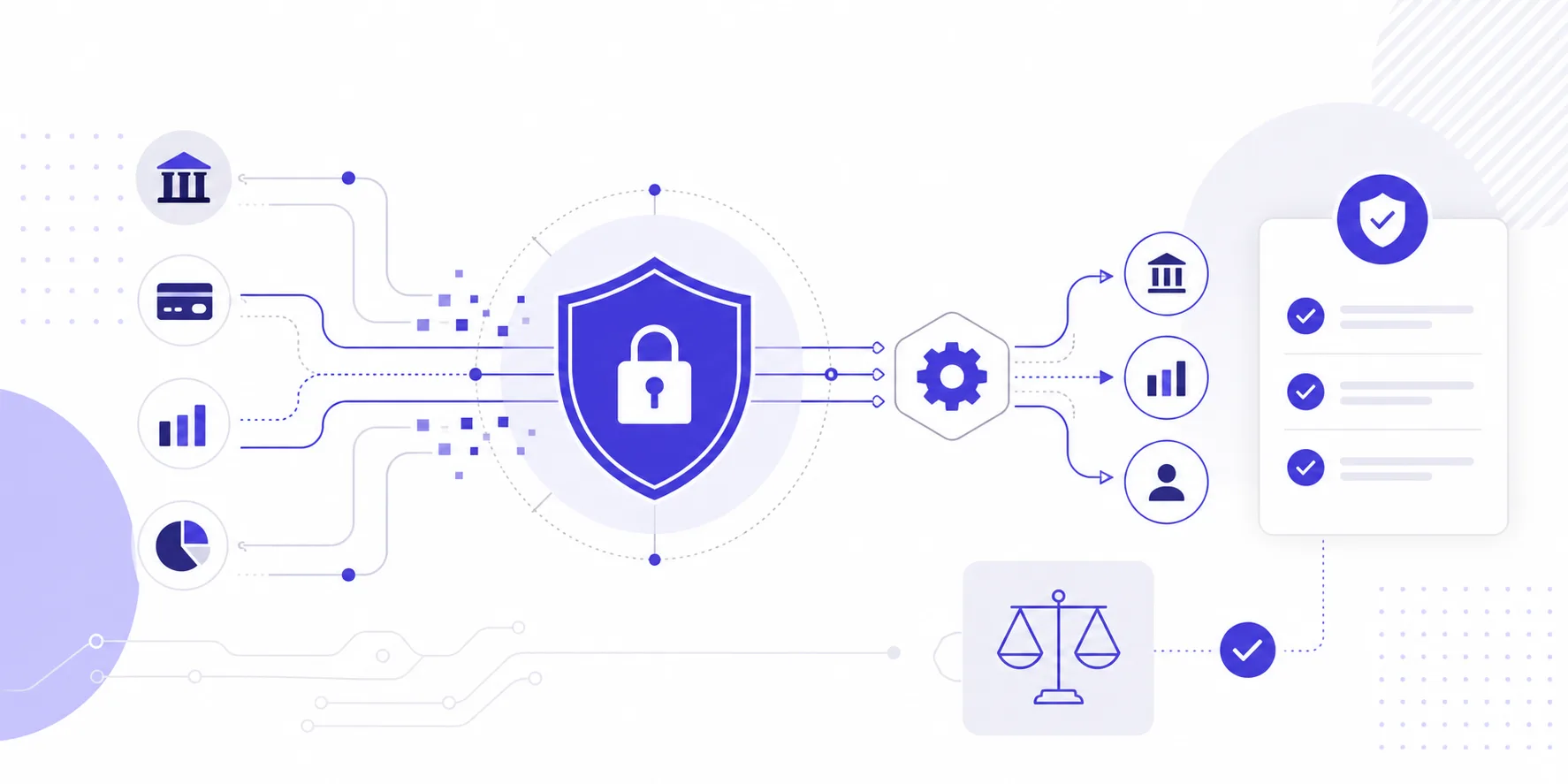
You can't rely on manual review to catch sensitive fields at scale. The right approach is a desensitization middleware layer that sits in the API call chain and runs every request through three stages.
Stage 1: Regex + rule engine
Structured fields are the easiest to catch:
import re

PATTERNS = {
    "id_card":   r"\b\d{17}[\dXx]\b",
    "bank_card": r"\b\d{16,19}\b",
    "phone":     r"\b1[3-9]\d{9}\b",
    "email":     r"\b[\w.+-]+@[\w-]+\.[a-zA-Z]{2,}\b",
}

def mask_sensitive(text: str) -> str:
    for label, pattern in PATTERNS.items():
        text = re.sub(pattern, f"[MASKED_{label.upper()}]", text)
    return text
Regex handles structured formats, but free-text leakage — "my card is the one starting with 6222" — needs a second pass.
Stage 2: Local NER model
Run a lightweight locally-deployed model (a fine-tuned Qwen 3 0.6B or a distilled GLM variant works well) to do named entity recognition over the prompt. Tag names, institution names, and account entities, then replace them before the request goes anywhere. This entire step stays inside the internal network.
Stage 3: Pseudonymization for fields that need to stay meaningful
Masking isn't always the right move. Many workflows need to preserve the business semantics of a field — "this is the same user as earlier in the session." Format-Preserving Encryption (AES-256 FPE) solves this: the real ID maps to a same-length random string, deterministically, so the model understands identity continuity without ever seeing the real value.
# FPE example using the ff3 library
python -c "from ff3 import FF3Cipher; \
  c = FF3Cipher('your-256bit-key', 'your-tweak', 10); \
  print(c.encrypt('110101199001011234'))"
For numeric fields like exact transaction amounts, use value generalization instead: replace ¥12,345.67 with a range label like [10000-50000]. For most analytical prompts, this doesn't meaningfully degrade model reasoning quality.
Audit log requirements that will hold up to review
The DSL requires that data processing activities be traceable. For AI API calls in financial institutions, your logs need to meet these minimum standards:
- Retention period: At least 3 years, consistent with financial institution electronic records standards
- Required fields: Call timestamp (millisecond precision), calling service name, target model identifier (e.g.
claude-opus-4-8,gpt-5.4), token consumption, hash of the desensitized prompt, hash of the response, operator ID - Do not log: Raw prompt plaintext (the desensitized version is fine), any model response that contains customer information
A minimum viable log record looks like this:
{
  "ts": "2026-06-15T09:23:11.482Z",
  "service": "risk-scoring-v2",
  "model": "gpt-5.4",
  "prompt_hash": "sha256:a3f9...",
  "response_hash": "sha256:7c2d...",
  "input_tokens": 1024,
  "output_tokens": 256,
  "operator_id": "emp_00123",
  "data_level": "L2_INTERNAL"
}
Store these logs in tamper-evident storage — object storage with WORM (Write Once Read Many) policy, or a blockchain notarization service. During an audit, regulators need to be able to trace from a prompt hash back to a specific business operation record.
Model selection and cross-border data transfer
Using offshore APIs like OpenAI or Anthropic adds another compliance layer: cross-border data transfer rules. Under China's Data Export Security Assessment Measures, financial institutions sending important data overseas must pass a security assessment first. In practice, there are three workable paths:
1. Private deployment Run models like DeepSeek V3 or Qwen 3 on internal GPU clusters. Data never leaves the network. This is the right call for core business workflows with high data sensitivity or strict latency requirements.
2. Domestic-node APIs Some providers operate independent nodes inside China, meaning no cross-border transfer, while still offering access to flagship models like GPT-5.4 and Claude Opus 4.8. Before signing anything, confirm the provider holds a valid LLM algorithm filing number (大模型算法备案号) — this is a legal prerequisite for offering large model services domestically.
3. Desensitized requests to offshore APIs After the full masking pipeline, send only structured analytical requests containing no personal information. This is the most common middle-ground approach, but your legal team needs to verify whether the desensitized payload still qualifies as "important data" under the relevant definitions.
These paths aren't mutually exclusive. A practical split: core customer data goes through private deployment; general document processing and coding tools (like using Claude Code or Codex for internal tooling) go through a compliant domestic API node.
One platform worth mentioning
If your team is building out the desensitization middleware and compliant call chain described here, the underlying API choice matters too. For our own internal AI testing, we've been using XycAi (https://www.xyc.ai) — a single OpenAI-compatible endpoint covering 200+ models, with GPT and Claude official models starting at 14% of list price. More importantly for financial teams: the platform holds a domestic LLM algorithm filing, supports enterprise compliance requirements with globally-issued invoices, and handles Claude Code, Codex, and Gemini CLI with a one-command setup. When you're running cross-model comparisons as part of a compliance evaluation, having all of that in one place saves real time.
One API for 200+ global AI models
GPT · Claude · Gemini official models from 14% of list price. Licensed LLM filing, CN2 direct connect at ~5ms, compliant global invoicing.
Try XycAi →