AI API Aggregator vs Direct API: How to Choose in 2025
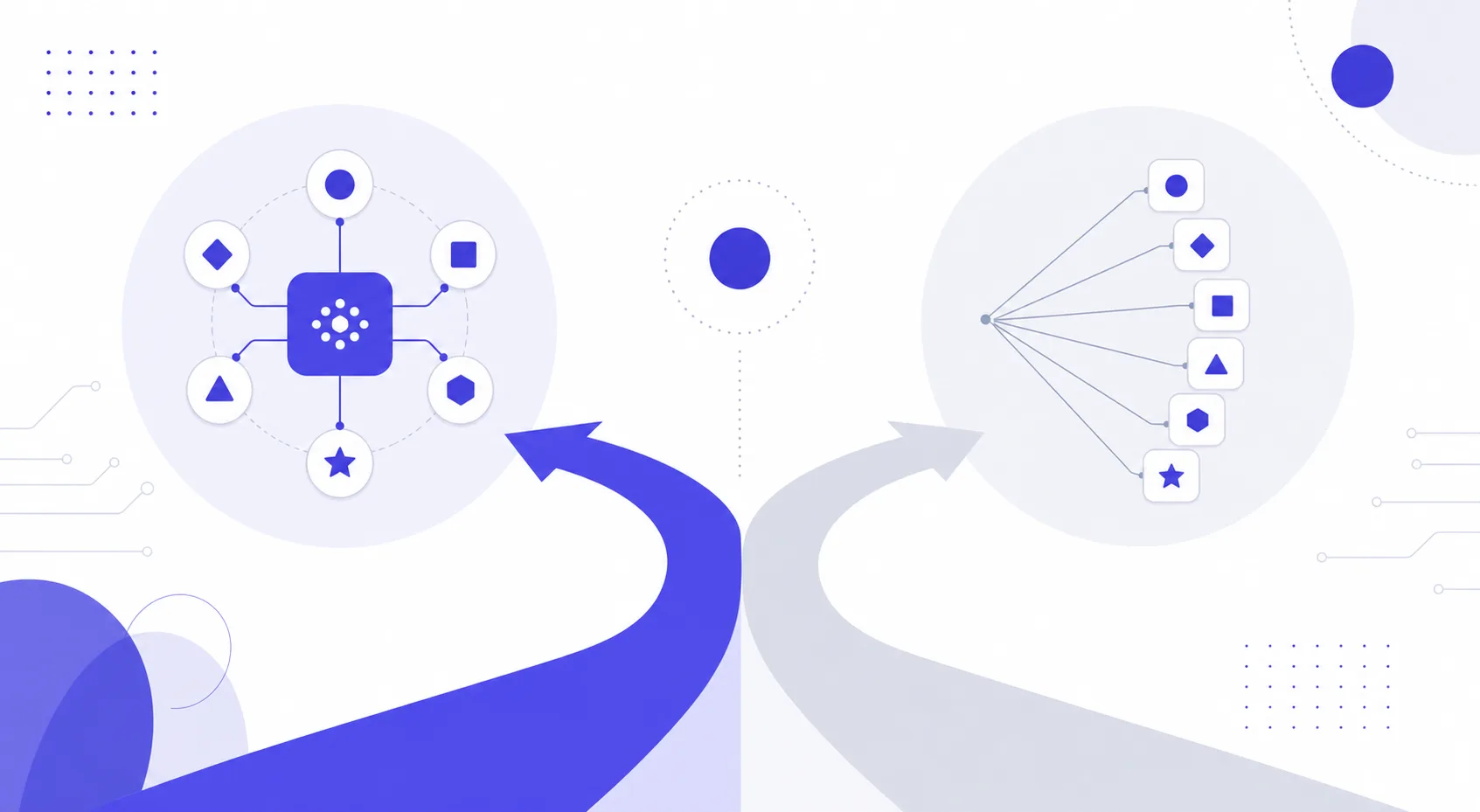
Every team integrating LLMs hits the same fork in the road early: call OpenAI, Anthropic, and Google directly, or route everything through an AI API aggregator? Neither answer is universally right — but picking the wrong one for your context creates real, ongoing costs in engineering time, invoicing headaches, and compliance exposure. Here's a systematic breakdown across four dimensions to help you make a defensible call.
Stability: Single-Point Dependency vs Traffic Orchestration
Direct API connections are theoretically clean, but they create a hard dependency on a single provider's infrastructure. OpenAI and Anthropic both experience regional outages several times a year — durations range from a few minutes to a few hours. For consumer-facing products or real-time support workflows, that kind of interruption is not a minor inconvenience.
Rate limits compound the problem. New accounts start at Tier 1 by default: GPT-5.4 allows roughly 800k TPM, while Claude Sonnet 4.6 sits around 40k TPM at the same tier. Climbing to Tier 4 or 5 requires a track record of sustained spend — there's no shortcut. If your traffic spikes before you've accumulated that history, you hit a wall.
A mature AI API aggregator solves this with traffic orchestration. The platform maintains a pool of accounts and nodes on the backend, automatically rerouting around rate-limited endpoints in a way that's completely transparent to your application. Some platforms also offer globally distributed points of presence with low-latency direct connections, which matters when cross-border network reliability is inconsistent.
Where this lands: - Low volume, tolerant of occasional downtime → direct API is fine - Daily token consumption above 500M, or you have SLA commitments on latency and availability → an aggregator's orchestration layer is worth the tradeoff
Cost: What the Sticker Price Doesn't Show
A fair cost comparison goes beyond list prices.
| Factor | Direct API | Aggregator |
|---|---|---|
| Pricing | Official list price | Typically discounted (as low as 10–30% of list) |
| Payment | USD credit card, regionally restricted | Local currency, bank transfer, corporate PO |
| Invoicing | USD receipts | Local VAT / compliant invoices |
| FX friction | ~2–3% in bank fees | None |
| Account suspension risk | Real (ToS violations, payment flags) | Absorbed by the platform |
For teams outside the US, direct API access carries two friction points that tend to get underestimated: payment (you need a foreign credit card or PayPal) and invoicing (USD receipts create extra work in corporate accounting). These aren't dealbreakers, but the hidden operational cost adds up over months.
Aggregator discounts come from volume purchase agreements — the platform buys in bulk and passes savings downstream. That said, apply some scrutiny: platforms offering very steep discounts sometimes operate through unofficial channels, which means no guarantees on model fidelity or data handling. A practical check: confirm whether the platform holds official partnership credentials or relevant compliance certifications.
Compliance: Algorithm Filings, Data Residency, and Audit Trails
Compliance is the dimension engineering teams most often defer — and the one with the highest cost when it catches up with you.
Direct API compliance gaps: - Data residency: Requests and responses transit foreign servers. If your payloads include personal user data, you may need a formal data transfer assessment under applicable privacy regulations. - AI service licensing: Deploying a consumer-facing product with AI-generated content may require your service provider to hold a recognized algorithm filing. If you're integrating a foreign API yourself, that obligation can fall on your own legal entity — and the filing process is non-trivial.
Where aggregators help: Compliance-oriented aggregators typically hold the necessary algorithm filings and operate as a formal service provider you can include in your vendor contracts. This shifts compliance burden off your internal legal team. They also tend to offer structured call logs and audit interfaces, which matters if your security posture requires documented log retention.
A practical rule of thumb: if your product is consumer-facing rather than a pure internal tool, work with an aggregator that already holds the relevant compliance credentials. Otherwise, the compliance cost lands squarely on your team.
Model-Switching Cost: The Real Engineering Problem
This is the dimension that gets the least attention in AI API aggregator vs direct API discussions — and arguably the most important one for engineering velocity.
Direct API code ties you to provider-specific SDKs, parameter structures, and error-handling patterns:
# Direct OpenAI
from openai import OpenAI
client = OpenAI(api_key="sk-...")
response = client.chat.completions.create(
    model="gpt-5.4",
    messages=[{"role": "user", "content": "..."}]
)
Switching to Anthropic means a different SDK, different parameter shapes, different error codes. If you're running multiple coding agents — Claude Code, Codex, Gemini CLI — each tool chain needs its own configuration maintained separately.
Aggregators solve this by exposing an OpenAI-compatible interface across all models. One base_url change covers everything:
# Same SDK, 200+ models
client = OpenAI(
    api_key="your-aggregator-key",
    base_url="https://api.xyc.ai/v1"
)
response = client.chat.completions.create(
    model="claude-sonnet-4.6",  # swap in any model string
    messages=[{"role": "user", "content": "..."}]
)
Claude Code integration is a single command:
ANTHROPIC_BASE_URL=https://api.xyc.ai/v1 \
ANTHROPIC_API_KEY=your-key \
claude
For teams running A/B tests across models, or routing by task type — long documents to Gemini 3, code to Claude Opus 4.8, fast Q&A to Haiku 4.5 — a unified interface reduces model switching from a refactor to a string change.
Decision Framework
A few questions to cut through the noise:
Go direct if you: - Operate outside regions with payment or compliance friction - Use a single model with no multi-model routing requirements - Need full control over every hop in the data chain and won't accept any intermediary
Go with an aggregator if you: - Need local currency billing and compliant invoicing - Are shipping a consumer product and can't absorb compliance responsibility internally - Have multi-model requirements or switch frequently between Claude Code, Codex, Gemini CLI, and similar tools - Are scaling up and need rate-limit failover built in
The two approaches aren't mutually exclusive. A common pattern: use an aggregator for development, multi-model evaluation, and non-critical pipelines, and revisit the direct API question for core production paths based on your specific compliance requirements.
For my own work, I use XycAi — one OpenAI-compatible endpoint covering 200+ models, with GPT and Claude official models starting at 14% of list price, a licensed LLM algorithm filing, and compliant invoicing out of the box. If you're tired of juggling separate API keys and compliance questions for every provider, it's the most practical starting point I've found.
One API for 200+ global AI models
GPT · Claude · Gemini official models from 14% of list price. Licensed LLM filing, CN2 direct connect at ~5ms, compliant global invoicing.
Try XycAi →