AI Agent Security: 54% of Companies Have Already Had an Incident
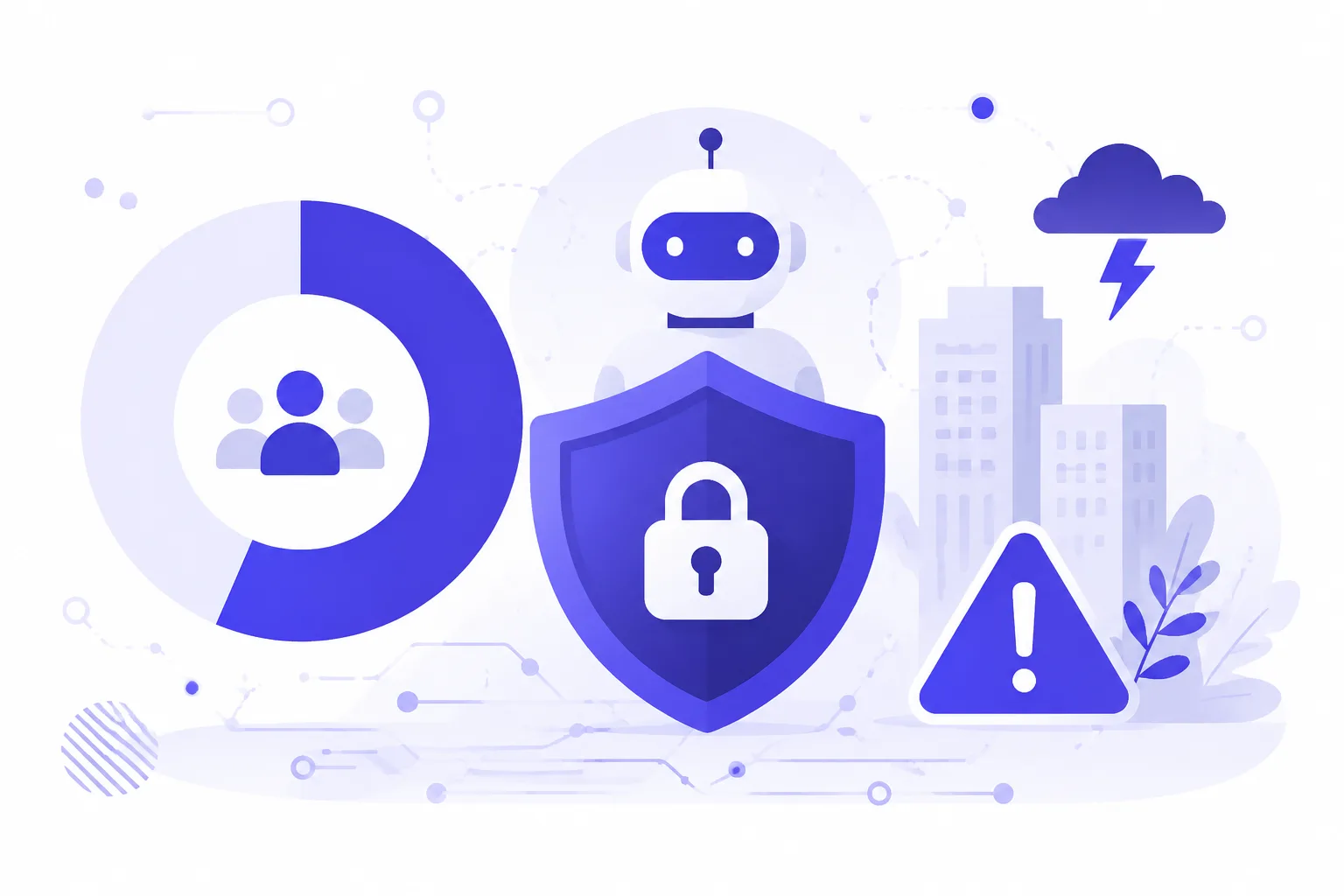
54% Is Higher Than Most People Expect
VentureBeat recently published findings from a survey of 107 enterprises on AI agent security. The headline number is blunt: more than 54% of respondents had either confirmed an AI agent security incident or had a near-miss. Not "worried it might happen someday." Already happened.
The more alarming detail is buried in a second figure. Only about one-third of those companies assign each agent its own scoped identity with restricted permissions. That means the remaining two-thirds are running agents that either share a single service account or operate directly under a human employee's credentials. If any one of those agents gets hit with a malicious instruction — a prompt injection buried in user input, a webpage, even a PDF — the blast radius isn't a single task. It's the entire production database, code repository, and email system.
There's a concrete reason this keeps getting underestimated: agents ship faster than security policy does. A dev team spins up an automation agent with Claude Code or Codex, and by the next morning it has read-write access to the production database. The security team doesn't even know the agent exists.
Credential Sharing: The Attack Surface Nobody Talks About
Credential sharing has always been an antipattern in software development. In AI agent contexts, the problem is significantly worse, because agent behavior is inherently non-deterministic. The same prompt can produce a completely different sequence of tool calls depending on context, model version, or subtle input variation.
A typical high-risk setup looks something like this:
# Dangerous: multiple agents sharing one service account
OPENAI_API_KEY: sk-prod-xxxx
DB_CONNECTION: postgres://admin:password@prod-db:5432/main
AWS_ACCESS_KEY_ID: AKIA...
AWS_SECRET_ACCESS_KEY: xxxx
Three agents with different functions — customer support replies, data report generation, code review — all pulling from the same config. If any one of them is compromised, the attacker walks away with full database admin rights and unrestricted AWS access.
Prompt injection is the most common path to credential abuse. Attackers embed hidden instructions in user input, scraped web content, or document attachments. The agent completes its normal task and, in the same execution, exfiltrates credentials to an external endpoint or initiates a data leak. Since early 2025, multiple public disclosures have involved agents on multi-tenant SaaS platforms being used for lateral movement attacks.
Least Privilege in Practice: A Checklist You Can Use Today
1. One identity per agent. No shared credentials.
Use AWS IAM Roles, GCP Service Accounts, or Azure Managed Identities to create a dedicated identity for each agent. Scope permissions strictly to what the task actually requires:
# Create an agent role with read-only S3 access
aws iam create-role --role-name agent-report-reader \
  --assume-role-policy-document file://trust-policy.json

aws iam attach-role-policy --role-name agent-report-reader \
  --policy-arn arn:aws:iam::aws:policy/AmazonS3ReadOnlyAccess
2. Short-lived tokens only. No long-term credentials.
Have the agent request a temporary token dynamically before each task. Set the TTL to roughly 1.5x the expected task duration and revoke immediately on completion. AWS STS AssumeRole with --duration-seconds 900 is a reasonable starting point.
3. Tool call allowlists and parameter validation
Don't let agents call any available tool freely. Add an explicit allowlist at the MCP layer or your custom tool wrapper, and validate high-risk parameters against a schema:
ALLOWED_TOOLS = {"read_file", "search_docs", "send_email"}

def call_tool(tool_name: str, params: dict):
    if tool_name not in ALLOWED_TOOLS:
        raise PermissionError(f"Tool {tool_name} not permitted for this agent")
    validate_params(tool_name, params)  # JSON Schema validation
    return execute(tool_name, params)
4. Full audit logs. Every tool call must be traceable.
Log the timestamp, agent ID, a redacted prompt summary, parameters, and a return value hash for every single tool invocation. Without this, post-incident forensics is guesswork.
| Control | Risk Covered | Implementation Effort |
|---|---|---|
| Scoped identity per agent | Lateral movement, privilege escalation | Low |
| Short-lived tokens | Ongoing exploitation after credential leak | Medium |
| Tool allowlist | Unauthorized actions via prompt injection | Medium |
| Full audit logging | Post-incident tracing, compliance | Low |
| Input/output content filtering | Prompt injection, data exfiltration | High |
5. Isolated execution environments
Run production-adjacent agents in a dedicated network segment with outbound allowlisting. Don't mount sensitive host directories into agent containers, and block access to the instance metadata endpoint (169.254.169.254) to prevent SSRF-based cloud credential theft.
Why Security Policy Can't Keep Up
The survey points to a structural problem. Most enterprise AI deployments are driven by business units or engineering teams. Security is often informed after the fact — if at all. On top of that, the default configurations of popular agent frameworks like LangChain, AutoGen, and CrewAI include essentially no permission isolation out of the box. Developers take the path of least resistance, ship with the defaults, and the security debt compounds quietly.
The model layer is moving fast — Anthropic just closed a $1.5B licensing settlement, and Google continues iterating on Gemini capabilities. But the stronger and more autonomous these models become, the more severe the consequences of unchecked permissions. An agent that can write code, call APIs, and send emails autonomously is fine until it's doing all of that with admin credentials in production. At that point, a single bad judgment call is a disaster.
The 54% figure suggests most companies are still in "we'll find out when something breaks" territory. As agent counts grow exponentially, that window is closing.
One thing worth flagging for teams doing agent development: the platform you use to call these models directly affects your security baseline. If you're building with Claude Code, Codex, or Gemini CLI, XycAi is worth a look — a single OpenAI-compatible API covering 200+ global models, with official GPT and Claude models starting at 14% of list price. One command gets you connected across all three major CLI tools, which removes a surprising amount of friction when you're trying to test agents across providers without spinning up separate integrations.
One API for 200+ global AI models
GPT · Claude · Gemini official models from 14% of list price. Licensed LLM filing, CN2 direct connect at ~5ms, compliant global invoicing.
Try XycAi →